Pressure Washer for Car: The Complete Home Wash Guide
A pressure washer for car washing works well at home when you pick a modest-pressure electric model, use a 25 or 40 degree fan tip, stay back from the paint and add a foam cannon for soap. Many car wash guides stay in roughly the 1,200 to 2,000 PSI range.
On this page (11 sections)
- What a pressure washer does for a home car wash
- PSI and GPM: what the numbers mean for a car
- Pick a pressure washer for car washing: four electric options
- Foam cannons, snow foam and soap
- How to wash a car with a pressure washer
- Is it safe for paint? What to avoid
- Gear that makes it easier: fittings, mitts and towels
- Electric, gas, cordless and garden hose compared
- Reviews of the washers we compared
- What to buy first for a home car wash
- Where to go next with a pressure washer for car washing
A pressure washer for car washing takes the loose grit off before a mitt touches the paint, and that is the main reason to use one at home. This guide covers what to buy, what the numbers mean, how to wash and what to avoid.
What a pressure washer does for a home car wash
A pressure washer rinses the dirt off before you touch the car, so your mitt has less grit to drag across the paint. A steady stream loosens road grime, pollen and mud, and most of it rinses away on the first pass.
A home wash with a washer usually runs in this order: rinse, foam, wait, rinse again, then dry. The rinse does the heavy lifting, and a foam cannon handles the soap.
Each step has its own tool, and the washer only handles the first.
| Step | Tool | Its job |
|---|---|---|
| Rinse | Washer with a 25 or 40 degree tip | Lifts loose grit and dust |
| Foam | Foam cannon and car wash soap | Coats every panel in soap |
| Wash | Wash mitt | Wipes off the film the spray leaves behind |
| Dry | Microfiber towels | Takes the water off before it dries on the paint |
What a washer cannot do
A washer does not replace the mitt for the final wash. Spray lifts loose grit, but a thin film of traffic grime can stay on the paint until a mitt wipes it off.
For each step in order, see how to pressure wash a car at home. If you are still wondering whether the job works at all, read can you pressure wash a car?
PSI and GPM: what the numbers mean for a car
PSI is how hard the water hits, and GPM is how much water comes out each minute. More PSI cuts grime faster but also raises the risk to paint, so the biggest number on the box is not the one to chase.
Many car wash guides keep to roughly 1,200 to 2,000 PSI. The washers in this guide list 1,800 to 2,100 PSI at the top end, so the tip you pick and the distance you hold matter more than the number.
Max PSI and rated PSI
Max PSI is the highest pressure the pump can reach, and rated PSI is the lower working figure some makers give. Westinghouse lists the ePX3100v at 2,100 max PSI and 1,800 rated PSI.
It also lists 1.76 max GPM at the lowest pressure and 1.2 rated GPM, so the most flow comes when the pressure is lowest, not at the top PSI. When you compare washers, set max against max and rated against rated.
GPM sets how fast you rinse
More flow rinses faster and gives a foam cannon more water to work with. The Chemical Guys PM2000 PRO lists 1.77 GPM, the Westinghouse ePX3100v 1.76 max GPM and the Greenworks 2100 PSI 1.2 GPM.
Expect a slower rinse from the Greenworks. For the Sun Joe SPX100-GO, check the manual for its flow before you order.
Hose, cord and weight
Hose length sets how far you can reach around a car without moving the washer. The Chemical Guys PM2000 PRO has a 25 ft flex hose and the Sun Joe SPX100-GO a 20 ft hose.
Check the hose on the exact Westinghouse or Greenworks model before you order, since it changes how far you can reach.
The Greenworks, the PM2000 PRO and the SPX100-GO each come with a 35 ft power cord that has GFCI protection. Follow the maker's manual for power and outlet use.
Weight matters if you carry the washer up steps or store it on a shelf. The Sun Joe SPX100-GO weighs 14.33 lb, the Westinghouse ePX3100v about 18 lb, the Chemical Guys PM2000 PRO 19.8 lb and the Greenworks 22 lb.
Spray tips: 25 or 40 degrees for paint
Use a 25 or 40 degree fan tip on paint. A narrow tip puts the same water into a much smaller spot, so it hits far harder than a wide fan does.
| Tip angle | What it does | On car paint |
|---|---|---|
| 0 degrees | A pinpoint jet | Never |
| 15 degrees | A narrow spray | Never |
| 25 degrees | General-purpose cleaning | The usual starting point |
| 40 degrees | A wide, gentle fan | The usual starting point |
| Turbo | Heavy-duty cleaning | Keep it off the car |
Follow your washer's manual and your car maker's guidance on distance, and start well back from the panel.
For more on pressure levels, read best PSI for washing a car. The best 2000 PSI electric pressure washers for cars roundup compares models in that range.
Pick a pressure washer for car washing: four electric options
For most home car washes, pick an electric washer with modest pressure, a hose that reaches around the car and an easy way to add soap. We compared the specs the makers publish for the four washers below.
Start with best pressure washers for washing cars for the wide view. If cost is your first filter, see best budget electric pressure washers for washing a car.
When you compare models, check these five things first:
- Max PSI. The four below list 1,800 to 2,100, so lean on the tip and your distance more than the number.
- Flow in GPM, since it sets how fast you rinse.
- Hose and cord length, so you can reach every side of the car.
- Weight and wheels, for storage and moving.
- A way to add soap, either a cannon or an onboard bottle.
For a checklist that works on any model, read how to choose an electric pressure washer for cars. Here is how the four compare on the numbers that matter for a car wash.
| Washer | Max PSI | Flow | Weight | Soap setup |
|---|---|---|---|---|
| Westinghouse ePX3100v | 2,100 (1,800 rated) | 1.76 max GPM | About 18 lb | Detachable foam cannon |
| Greenworks 2100 PSI | 2,100 | 1.2 GPM | 22 lb | Soap applicator |
| Chemical Guys PM2000 PRO | 2,030 | 1.77 GPM | 19.8 lb | Universal cannon connections |
| Sun Joe SPX100-GO | 1,800 | Check the manual | 14.33 lb | Onboard 13.53 oz foam bottle |
Westinghouse ePX3100v: a compact pressure washer for car washing
The Westinghouse ePX3100v is the pick for a compact washer with a cannon in the box. Westinghouse lists 2,100 max PSI and 1.76 max GPM, a built-in carry handle and a 3 year limited warranty on service, labor and parts.
Westinghouse says the pump stops when you release the trigger, which helps conserve energy and protect the motor. If small size is your top need, best compact electric pressure washers for car detailing is the roundup to read next.
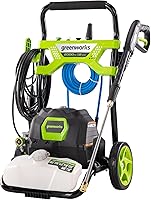
Greenworks 2100 PSI: no gas, oil or pull cord
The Greenworks is the simple electric setup. Greenworks says there is no gas, oil, spark plugs, air filters or pull cord to deal with, and it starts with a push button.
It runs at 2,100 PSI and 1.2 GPM, and at 22 lb it is the heaviest of the four. A telescoping handle pulls out for moving it and collapses for storage.
Greenworks includes a 25 degree tip for general cleaning, a 40 degree tip for gentle cleaning, a turbo tip for heavy-duty jobs and a soap applicator. Use the 25 or 40 degree tip on paint, and keep the turbo tip off it.
For washers that handle car and home jobs, see best electric pressure washers for car and home use.
Chemical Guys PM2000 PRO: casters and a 25 ft hose
Choose the PM2000 PRO if you want wheels and a long hose. Chemical Guys lists 2,030 PSI and 1.77 GPM, with a 25 ft flex hose and a 35 ft GFCI cord.
Chemical Guys says its universal connections take foam cannons, snubby guns and rapid-release fittings without adapters. It calls the washer a quiet, portable electric setup, and best electric pressure washers for car detailing covers more washers for detailing work.
Sun Joe SPX100-GO: the lightest of the four
The Sun Joe SPX100-GO is the one to take if weight and storage matter most. It weighs 14.33 lb and lists 1,800 PSI, the lowest maximum of the four.
Its tips are 0, 15, 25 and 40 degrees, so start with the 25 or 40 on paint. Sun Joe says its Total Stop System shuts the motor off when you release the trigger.
Sun Joe backs the washer with a 2-year warranty, plus 90 days of bonus coverage when you register at shopjoe.com.
Foam cannons, snow foam and soap
A foam cannon attaches to your washer and turns car soap and water into a thick foam you spray over the whole car. It is not required, but it puts soap on every panel before the rinse, which is why many home washers add one.
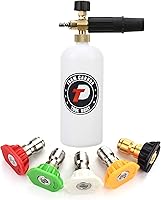
Tool Daily Foam Cannon for a quick connect washer
The Tool Daily cannon holds 1 liter and has to connect to a standard 1/4 inch quick connect gun or wand. Tool Daily says it will not attach to a garden hose or faucet directly.
It comes with five tips at 0, 15, 25, 40 and 65 degrees, and only the 25 and 40 degree tips belong on paint. To match any cannon to your washer, read how to choose a foam cannon for your pressure washer.
When you compare cannons, look for four things:
- A fitting that matches your gun or wand, such as the 1/4 inch quick connect on the Tool Daily.
- A bottle size that suits your wash, since the Tool Daily bottle holds 1 liter.
- A top knob that sets how thick the foam is, which Tool Daily says it has.
- Spray tips you will actually use, which means 25 and 40 degrees on paint.
Chemical Guys Mr. Pink for foam cannons
Chemical Guys says Mr. Pink is pH-balanced and cleans without stripping wax, sealant or ceramic coatings.
If you have a ceramic coating, also check what the coating maker recommends for soap. Use car wash soap only, as the label says, and never mix chemicals.
Cannon, foam gun or no washer at all
A cannon and a foam gun both put soap on a car, so the choice comes down to the kind of foam you want and how each fits your washer. Foam cannon vs foam gun: which is better for cars? sorts out the trade-offs.
No washer? Snow foam is a thick foam for cars, and how to snow foam a car without a pressure washer covers the options.
Is a foam cannon worth it?
A cannon is one more part to fill, use and clean, so it pays off most when you wash often or want an even layer of soap. Is a foam cannon worth it? works through the trade-offs in more detail.
The Westinghouse ePX3100v comes with a detachable cannon, so you may not need to buy one. Best pressure washers with a foam cannon for cars lists more washers that come with one.
Mixing the soap and fixing thin foam
The soap label sets the mix, so follow it rather than guessing. Foam cannon dilution ratio: how much soap to use explains how to read that label.
If the foam comes out thin or not at all, the mix is the first thing to check. Foam cannon not foaming: causes and fixes walks through the other causes in order.
How to wash a car with a pressure washer
Rinse the car first, foam it, wait a few minutes, then rinse again and dry before the soap can dry on the paint. Park in shade and let the car cool before you start, so the foam does not dry while you work.
- Rinse the whole car with plain water to lift loose dirt.
- Attach the foam cannon to the washer and fill it with car soap and water as the label says.
- Foam the car one section at a time, from the bottom up or top down.
- Wait a few minutes, following the soap label, and keep the foam from drying.
- Swap the cannon for a 25 or 40 degree tip, rinse the foam off, then dry with clean microfiber towels.
Work from the top down when you rinse, so the soap runs off the car instead of sitting on the lower panels. Wheels and lower panels hold the most grime, so wash them last with their own mitt and towel.
For the cannon steps in more detail, read how to use a foam cannon on a car. For the full method with each step explained, see how to pressure wash a car at home.
A quick setup check before you spray
Run through this list once, and the wash itself goes faster.
- Park in shade and let the panels cool.
- Fit the 25 or 40 degree tip.
- Check that the cannon fitting matches your gun or wand.
- Fill the cannon with soap and water as the soap label says.
- Set out two mitts and a stack of clean towels.
- Follow the maker's manual for the water and power connections.
Common mistakes to avoid
- Letting the foam dry on the paint, which can leave spots.
- Rinsing with a narrow 0 or 15 degree tip, which can damage paint.
- Skipping the first rinse, so grit gets pushed across the finish.
- Mixing soap with other cleaning products.
Is it safe for paint? What to avoid
A pressure washer can work well on many car paint jobs when you use a wide fan tip and keep the wand back. It can damage paint that is chipped, peeling, loose or poorly repainted, so check the paint before you start.
- Use a 25 or 40 degree tip as the usual starting point.
- Keep 0 and 15 degree tips off the paint, since a narrow spray can damage it.
- Start with the wand well back from the panel, and follow your washer's manual and car maker's guidance on distance.
- Don't aim at chipped or peeling paint, loose trim or panel edges.
- Use only car wash soap as the label says, and never mix chemicals.
For wrapped cars, paint protection film, soft tops, convertible roofs and engine bays, follow the maker's care guide or ask a pro.
Check the paint before you spray
Look at each panel in good light for lifting clear coat, flaking paint or bubbles. Chips and peeling spots call for the most caution, since loose paint is the most likely to lift.
Repainted panels deserve the same care, because a poor repaint may not bond well to the original finish. Are pressure washers safe for car paint? goes deeper on reading paint condition before you start.
Gear that makes it easier: fittings, mitts and towels
Check the fitting first, because a cannon only works if it connects to your gun or wand. The Tool Daily cannon and the Greenworks washer both use a 1/4 inch quick connect, and a mismatch means the cannon will not attach.
Compare the fittings before you order, and read foam cannon fittings: quick connect, adapters and orifice if the sizes do not line up.
Use a soft wash mitt for the body and a second mitt for the wheels, so brake dust and grit stay off the paint. Dry with clean microfiber towels, and keep a separate towel for the wheels.
A towel that picked up grit from the wheels can scratch the next panel, so lay out a clean, dry set before you start drying.
Electric, gas, cordless and garden hose compared
For most home car washes, an electric washer is the simpler choice because it needs no fuel or oil. Gas, cordless and garden hose setups each give something up, and the short sections below show what.
Electric or gas
Gas models need fuel and oil, and they must never run indoors or in a closed garage, so follow the manual and keep them outside. An electric washer skips both.
It does need an outlet within reach of its cord, so follow the maker's manual for power and outlet use. Electric vs gas pressure washer for washing a car compares the trade-offs in more detail.
Cordless or corded
A cordless washer trades the cord for battery life, so check how long one charge lasts before you plan a whole-car wash. Cordless vs corded pressure washer for washing a car explains the choice.
If you want a battery model, best cordless pressure washers for washing your car is the next stop.
Washer or garden hose
A garden hose can rinse a car, but it does not push off caked-on dirt the way a washer does. Pressure washer vs garden hose for washing a car compares the two.
Reviews of the washers we compared
Four reviews cover the Westinghouse ePX3100v, the Chemical Guys PM2000 PRO, the Greenworks 2000 PSI and the Sun Joe SPX3000. The Greenworks and Sun Joe reviews are not the exact models in the picks above, so check the model name before you compare specs.
- Westinghouse ePX3100v pressure washer review
- Chemical Guys PM2000 PRO pressure washer review
- Greenworks 2000 PSI pressure washer review
- Sun Joe SPX3000 pressure washer review
To weigh two models head to head, Westinghouse ePX3100 vs Sun Joe SPX3000 for car washing puts them side by side.
What to buy first for a home car wash
Start with a modest-pressure electric washer and a soft mitt, then add the soap and tools that fit how you wash. Here is a simple list for a first setup.
- A washer with a hose and cord long enough for the car.
- Car wash soap made for foam cannons or buckets.
- A foam cannon, if the washer does not already include one.
- A soft wash mitt and a second mitt for the wheels.
- Clean microfiber towels for drying.
Add a cannon once you know how much soap coverage you want. Read the foam cannon fittings guide first, so you know what connects to what.
Where to go next with a pressure washer for car washing
Pick the Westinghouse ePX3100v if you want a cannon in the box and a compact frame, or the Sun Joe SPX100-GO if weight matters most.
Go with the Greenworks if you want no gas or oil to maintain, or the Chemical Guys PM2000 PRO if you want casters and a 25 ft hose.
Four next reads cover the rest of the job:
- How to pressure wash a car at home for the full method.
- Best PSI for washing a car for pressure choices.
- How to use a foam cannon on a car for the cannon steps.
- Are pressure washers safe for car paint? before you start on older paint.
Frequently asked questions
What is the best pressure washer for a car?
The Westinghouse ePX3100v is the pick to start with, since it is compact and comes with a detachable foam cannon. Choose the Chemical Guys PM2000 PRO if you want casters and a 25 ft hose, or the Sun Joe SPX100-GO if you want the lightest washer.
How many PSI do you need to wash a car?
Many car wash guides stay around 1,200 to 2,000 PSI, and a wide fan tip is the usual starting point. A bigger number is not better for a car, since more pressure raises the risk to paint, so give the soap more time before you try anything stronger.
Do you need a foam cannon to wash a car with a pressure washer?
No, you can rinse with the washer and then wash by hand with a bucket and mitt. A foam cannon is the faster way to put soap over the whole car, and some washers, such as the Westinghouse ePX3100v, come with one.
Can a pressure washer damage car paint?
Yes, it can, and chipped, peeling, loose or poorly repainted paint is the most at risk. Use a 25 or 40 degree fan tip, keep the wand well back from the panel, and never use a narrow 0 or 15 degree tip on paint.