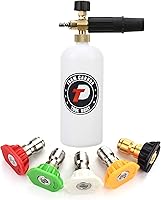
Foam Cannon Fittings: Quick Connect, Adapters, Orifice
Most foam cannon fittings for electric washers use a 1/4 inch quick connect, but many washers use M22 threads or a 3/8 inch quick connect. Check your gun and wand before you buy an adapter.
On this page (8 sections)
Foam cannon fittings for electric washers most often use a 1/4 inch quick connect. Many washers, though, use M22 threads or a 3/8 inch quick connect, so match your gun and wand before you buy an adapter.
This guide covers the connector sizes, the M22 thread difference, adapters, garden hose parts, the orifice and leaks. Use it to match the parts you already own before you buy new ones.
Foam cannon fittings: which connector does your washer use?
Look at the end of your gun or wand and at the hose end, because those two ends tell you the connector size. The washer's manual confirms the size for your exact model.
A washer has up to three joints: the pump outlet to the hose, the hose to the gun, and the gun or wand to the cannon. The cannon joint is the one that matters most here, but a mismatch at any joint can leak.
Greenworks says its 2100 PSI electric washer uses a 1/4 inch universal quick connect system. If you own a Greenworks, the Greenworks website is the place to confirm the connector for your model.
If you're still choosing a washer, Best Pressure Washers With a Foam Cannon for Cars covers the options.
This table sums up the fittings named in this guide.
| Fitting | Size | Where it shows up |
|---|---|---|
| Quick connect | 1/4 inch | Westinghouse cannon, Greenworks washer, Raincovo adapters |
| Quick connect | 3/8 inch | Twinkle Star M22-14 swivels |
| Thread | M22 14 mm | Raincovo and Twinkle Star adapters |
| Thread | M22 15 mm | Hoses on some electric washers, which Twinkle Star says its kit will not fit |
1/4 inch vs 3/8 inch quick connect
A 1/4 inch quick connect and a 3/8 inch quick connect are different sizes, so they will not join without an adapter. A quick connect is a push-on fitting that snaps into place without screwing, which is why Raincovo says it makes swapping accessories faster.
Westinghouse says its cannon fits most pressure washers through a 1/4 inch female quick connect. It backs the cannon with a 180-day limited warranty.
Check the size on your gun or wand before you buy, because a 3/8 inch fitting needs an adapter to reach a 1/4 inch cannon. Once it connects, measure the soap with Foam Cannon Dilution Ratio: How Much Soap to Use.
How to tell which quick connect you have
Look for a size stamped on the fitting or printed near it. If the fitting has no marking, the washer's manual or the maker can confirm the size from your model number.
Both the Westinghouse cannon and the Greenworks washer use a 1/4 inch fitting. Check the fitting on your wand, though, not just the brand name on the washer.
M22 threads: 14 mm and 15 mm
M22 threads come in 14 mm and 15 mm versions, and a 15 mm fitting on a 14 mm part may leak. Twinkle Star says its M22-14 swivel has a 14 mm inside diameter, not 15 mm.
Twinkle Star also says some electric washers, like the SunJoe, AR Blue and Active VE52, use M22-15 mm hoses that will not work with its kit. It says the kit suits most gas and electric pressure washers, but the M22 size still has to match.
Foam cannon fittings that use M22 threads
If your wand or hose has M22 threads, pick a fitting that matches that thread before anything else. The two sizes can look alike, so check the inside diameter and the thread size against your part, not just the name on the box.
Adapters and fitting kits
An adapter is the simplest fix when your gun uses one size and your cannon uses another. Raincovo's set has 4 pieces that move an M22 14 mm thread to a 1/4 inch quick connect.
Raincovo says its brass parts handle up to 4500 PSI, with a maximum working temperature of 300 °F. Twinkle Star also uses brass, plus stainless steel, and rates its kit up to 5,000 PSI.
Twinkle Star's kit is wider. It includes M22-14 mm swivels with 3/8 inch quick connect fittings, plus pieces that link 3/8 inch, 1/2 inch and 3/4 inch sizes.
Use an adapter only when the sizes differ, and check the thread on both sides. Each adapter adds another joint, and every joint is one more place for a leak.
Before you buy, write down 3 things:
- The thread or fitting on the washer outlet.
- The connector on your gun or wand.
- The connector on the cannon.
With 3 written sizes, the match is easy to check at the store or online.
Garden hose fittings vs pressure washer fittings
A garden hose fitting is a different thread from a pressure washer fitting, so use parts made for the washer's outlet. Garden hose parts are not built for the pressure a washer makes, so keep them off the high-pressure side.
Twinkle Star says the 3/4 inch parts in its kit turn garden hose threads into quick release connectors. Follow the washer's manual for the water inlet, since that side has its own connection.
The cannon belongs on the gun or wand, not on the garden hose or a faucet. Keep that in mind when you add adapters, so each part sits between the gun and the washer.
What the orifice size does
The orifice is the small hole inside the cannon that the water passes through. Its size affects how much water and pressure the cannon needs.
Cannon makers sometimes state the orifice size, so look in the manual if you need the number. It is worth knowing before you pair a cannon with a washer that has modest flow.
A blocked orifice can thin the foam, so keep it clear. For cleaning steps, see Foam Cannon Not Foaming: Causes and Fixes.
Leaks and loose fittings
Leaks at a fitting usually come from a size mismatch, a loose joint or a worn seal. Twinkle Star warns that a 15 mm fitting on its 14 mm swivel may leak, so check the size first.
When a joint drips, work down this list:
- Is the size right for both parts, including 14 mm or 15 mm on M22 threads?
- Is the quick connect pushed fully on?
- Is the thread snug by hand?
- Does the seal look worn or out of place?
Push each quick connect fully on and tug it to make sure it holds. Tighten threaded joints by hand, and check for drips before you run the washer.
A joint that held last time can loosen with use, so check the connections each time you change parts. If a joint still leaks, shut off the washer and check the size again before you add another part.
Choosing foam cannon fittings for your washer
Match the connector on your washer first, then pick the cannon and the adapter that fit it. That keeps you from buying parts that do not join.
Pick a cannon with a 1/4 inch quick connect if your gun or wand uses that size. Pick Raincovo's M22 set if your wand uses M22 14 mm threads, or Twinkle Star's kit if you need more sizes.
If the sizes still do not match after you check, stop and ask the washer maker before you buy anything else. Once the fittings match, follow How to Use a Foam Cannon on a Car for the wash steps.
For a new washer and cannon together, start with How to Choose a Foam Cannon for Your Pressure Washer. The Pressure Washer for Car: The Complete Home Wash Guide covers the whole process.
Frequently asked questions
Will a foam cannon fit any pressure washer?
No, not every one. Westinghouse says its cannon has a 1/4 inch female quick connect that works with most pressure washers, but the fitting on your gun or wand still has to match, so check that size and the thread before you buy.
What size quick connect is a foam cannon?
Many foam cannons use a 1/4 inch quick connect, including the Westinghouse cannon in this guide, and Greenworks says its 2100 PSI washer uses the same 1/4 inch system. A 3/8 inch quick connect is a different size, so you need an adapter to join the two.
Do I need an adapter for a foam cannon?
Only when the sizes do not match, such as an M22 thread or a 3/8 inch quick connect on your wand and a 1/4 inch fitting on the cannon. Raincovo's 4-piece set covers M22 14 mm to 1/4 inch, and Twinkle Star's kit covers more sizes.
What is the orifice in a foam cannon?
The orifice is the small hole inside the cannon that the water passes through, and its size affects how much water and pressure the cannon needs. A blocked orifice thins the foam, and the cannon maker's manual is the place to find the exact size.