Best PSI for Washing a Car
The best PSI for washing a car is moderate: many car washers choose a model in the 1,200 to 2,000 PSI class with a 25 or 40 degree fan nozzle. No PSI is safe for every paint job, so follow the washer maker's and the car maker's instructions.
On this page (8 sections)
- The short answer: how many PSI for a car
- Max PSI vs rated PSI
- Why GPM matters as much as PSI
- Nozzle angle and distance change the pressure on paint
- Why more PSI is not better on car paint
- Electric washers in the common car-wash PSI range
- What to do if your washer is stronger than you need
- Pick the best PSI for washing a car at home
The best PSI for washing a car is a moderate one. Many car washers choose a model in the 1,200 to 2,000 PSI class, paired with a 25 or 40 degree fan nozzle and some distance from the paint.
No PSI is safe for every paint job. Chipped, peeling or loose paint can be damaged even at moderate pressure, so the number is only part of the answer.
The short answer: how many PSI for a car
Many car washers stay in the 1,200 to 2,000 PSI class, and go gentler if the paint looks thin, chipped or loose. Paint damage is hard to undo, so it pays to start low and stay back.
That class is a common starting range, not a safety guarantee. Your paint, your nozzle and your distance each change the force the panel really feels.
A simple order for your first pass:
- Fit a 25 or 40 degree fan nozzle.
- Stand back, and try the spray on a low, hidden spot first.
- Soak the car with soap before you think about more force.
- Keep the wand moving, and rinse from the top down.
If you are still deciding whether a washer belongs near your paint at all, read Can You Pressure Wash a Car? first.
Max PSI vs rated PSI
Max PSI is the highest pressure a washer can reach, and rated PSI is the pressure it is built to run at in normal use. For everyday washing, the rated figure is the better guide.
Westinghouse gives both for the ePX3100v: 2100 max PSI and 1.76 max GPM, with 1800 rated PSI and 1.2 rated GPM. The 1.76 GPM figure applies at the lowest pressure, according to Westinghouse.
That gap is easy to miss, because product names usually lead with the bigger number. The ePX3100v is sold as a 2100 PSI washer, but its rated figure is 1800 PSI.
When a box shows only one PSI number, check whether it is a max or a rated figure before you compare washers.
Why GPM matters as much as PSI
GPM means gallons per minute, which is how much water the washer moves. Flow carries soap and loosened dirt off the paint, so a washer with low flow can feel slow to rinse even when its PSI looks strong.
Think of PSI as the push and GPM as the water that carries the dirt away. Both Greenworks models in this guide run at 1.2 GPM, while the Chemical Guys PM2000 PRO gives 1.77 GPM.
Flow also affects a foam cannon, so a low-GPM washer may give thinner foam. A garden hose has no pump at all, and Pressure Washer vs Garden Hose for Washing a Car shows how the two compare.
Nozzle angle and distance change the pressure on paint
A narrower nozzle focuses the same water on a smaller spot, so it hits harder. Skip the 0 and 15 degree tips on paint, and start with a 25 or 40 degree fan nozzle.
Here is how the usual tips compare on a car:
- 0 degree: a pencil-thin jet, so keep it off paint.
- 15 degree: still narrow, so keep it off paint too.
- 25 degree: a general-purpose fan, and a common starting tip for a car.
- 40 degree: the widest fan in most sets, and the one Greenworks calls gentle.
Distance changes the force too, because the closer the tip, the harder the spray lands. Start farther back than feels necessary, and follow the distance in your washer's manual.
Watch the paint as you go. If the spray lifts an edge, a chip or a flake, stop, back away and look at the area before you continue.
Best PSI for washing a car with older paint
Older or worn paint can chip or lift under pressure, whatever the number on the box says. When the paint looks tired, use the 40 degree tip, back off, keep the wand moving and hand wash any spot that looks weak.
For repainted panels and other weak spots, read Are Pressure Washers Safe for Car Paint?.
Why more PSI is not better on car paint
More PSI does not make a car wash better on its own, because the extra force lands on the paint. It can lift loose paint or chip a weak spot.
Stuck-on spots, such as dried bugs or tar, usually need a longer soak and a soft mitt, not more pressure. Moving closer to a stubborn spot is a common way to lift paint instead of dirt.
Soap, flow, the right tip and patience do most of the work. A foam cannon puts a layer of soap on the car before the rinse, so the dirt has time to loosen without extra force.
Electric washers in the common car-wash PSI range
Electric washers need no gas or oil, and the four in this guide all sit in or just above the 1,200 to 2,000 PSI class. We compared their specs, and the differences come down to flow, extras and reach.
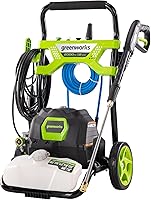
Greenworks calls the 2000 PSI model a medium-duty washer for vehicles, patio furniture and grills. Its motor shuts off when the spray wand is not engaged, which Greenworks says saves energy and helps the pump and motor last.
Use car wash soap as its label says, and never mix chemicals. Greenworks backs the 2000 PSI model with a 3-year warranty.
The Greenworks 1700 PSI is aimed at light-duty cleaning, including cars, trucks and motorcycles. It has no gas, no oil and no pull cord, plus a 35 ft power cord with a GFCI plug, so follow the maker's manual for power.
If you only want models at the top of this range, see Best 2000 PSI Electric Pressure Washers for Cars.
What to do if your washer is stronger than you need
Use the widest nozzle, stay back and let the soap do the work. A stronger washer does not give a better wash, only less room for error.
- Fit the 40 degree fan nozzle.
- Stand farther back than you would with a weaker washer.
- Keep the wand moving, and never hold it on one spot.
- If your washer has a pressure setting, follow the manual for the car-washing setting.
If the machine is far stronger than your car needs, a gentler model may suit you better. How to Choose an Electric Pressure Washer for Cars walks through the numbers to compare.
Pick the best PSI for washing a car at home
Choose by your paint first, then by flow, reach and the extras you want.
- Pick the Greenworks 1700 PSI if you want the lower end of the class for light-duty washing, with 25 and 40 degree nozzles in the box.
- Pick the Greenworks 2000 PSI if you want an on-board soap tank at the top of the class.
- Pick the Westinghouse ePX3100v if you want a detachable foam cannon and clearly stated max and rated figures, backed by a 3-year limited warranty.
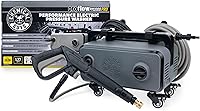
- Pick the Chemical Guys PM2000 PRO if you want more flow, at 1.77 GPM, and a 25 ft hose.
Whatever you pick, begin with the wide nozzle and keep your distance. For the full setup, start with the Pressure Washer for Car: The Complete Home Wash Guide, then follow How to Pressure Wash a Car at Home step by step.
Frequently asked questions
Is 2000 PSI too much for washing a car?
Not by the number alone, since many car washers choose models in the 1,200 to 2,000 PSI class. Nozzle angle, distance and the condition of the paint matter more, so start with a 25 or 40 degree tip, stay back, and follow both the washer maker's and the car maker's instructions.
Is 1500 PSI enough to wash a car?
Yes, 1,500 PSI sits inside the 1,200 to 2,000 PSI class many car washers use, and it is enough for routine dirt when car wash soap does the loosening. If dirt does not lift, soak the area again and rinse, rather than rushing in close to the paint.
What nozzle should you use to wash a car?
Start with a 25 or 40 degree fan nozzle, since a wide fan spreads the force over more paint. Skip the 0 and 15 degree tips on paint because they focus the spray into a narrow stream, and check your washer's manual to see which tip is which.
How far should a pressure washer be from a car?
Start farther back than feels necessary, then move in a little at a time only if the dirt will not lift. Washer makers give their own distances, so follow your manual first, keep the wand moving, and check the car maker's guidance if the paint looks worn.